The Crash Team | April 3, 2026 | Car Accidents
Photos, witness information, and medical documentation often become the foundation of insurance claims and personal injury cases, including car accidents. In Texas, gathering this information early can significantly affect your ability to prove what happened.
At The Crash Team, we regularly see how proper documentation strengthens a case. When drivers take the time to preserve evidence after a collision, it often leads to clearer liability decisions and stronger negotiations with insurance companies.
If you’ve been injured in a Sugar Land car accident, call our car accident lawyers at 713-300-0000 for a free consultation. We’ll help you secure all the documents you need to build a strong case and pursue the compensation you deserve.
Why Evidence Matters in Texas Car Accident Claims
Evidence is the backbone of any car accident claim. In Texas, fault determines who pays for damages because the state follows an at-fault insurance system. This means the driver responsible for the crash is typically liable for medical expenses, property damage, and other losses.
Texas also uses a legal principle called modified comparative fault under Texas Civil Practice and Remedies Code §33.001. If a driver is found to be partially responsible for an accident, their compensation may be reduced by their percentage of fault. If they are more than 50 percent responsible, they cannot recover damages at all.
This is why documentation matters. Evidence helps clarify exactly what happened and who was responsible.
Strong evidence can help demonstrate:
- Which driver caused the crash
- The severity of the impact
- Road or weather conditions at the time
- The extent of injuries suffered
- Whether traffic laws were violated
Without proper documentation, accident claims can become a matter of competing narratives. Insurance companies often take advantage of uncertainty when negotiating settlements.
Photographing the Accident Scene
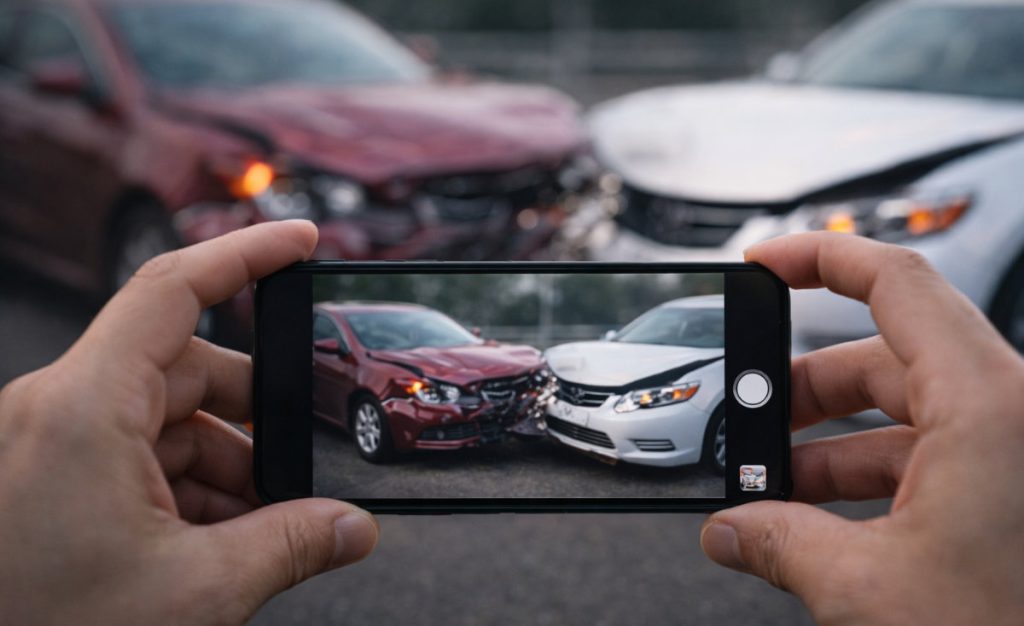
Photos are often the most accessible and persuasive form of evidence after a car accident. Most drivers carry a smartphone, which means documenting the scene is usually possible within minutes of the collision.
Images help preserve details that may disappear quickly. Vehicles get towed, debris gets cleared, and traffic resumes. Once the scene changes, those details can be difficult to reconstruct.
Important photographs to capture include:
- Damage to all vehicles involved
- Skid marks or debris on the roadway
- Traffic signals, stop signs, or lane markings
- Road conditions, including weather-related hazards
- The surrounding intersection or roadway layout
- Visible injuries
Angles matter. Wide shots provide context, while close-ups show specific damage. When possible, photographs should also include timestamps.
At The Crash Team, we often review accident scene photographs during the early stages of a case. These images can help accident reconstruction experts understand the mechanics of the collision and support arguments during insurance negotiations.
Gathering Information From Drivers and Witnesses
After a crash, drivers are legally required to exchange certain information. Under Texas Transportation Code §550.023, individuals involved in a collision must provide identifying details to one another.
This exchange ensures that both parties can report the accident and pursue insurance claims.
Information that should be collected includes:
- Names and contact information for all drivers
- Driver’s license numbers
- License plate numbers
- Vehicle make, model, and color
- Insurance company names and policy numbers
Witnesses can also play an important role. Independent bystanders often provide objective perspectives about what happened. Their statements may help confirm whether a driver ran a red light, failed to yield, or was speeding.
When possible, obtain the witness’s name and phone number. Even a brief statement recorded on a phone can sometimes help clarify the sequence of events. In more serious cases, witness testimony can become critical evidence during settlement negotiations or trial proceedings.
Requesting the Police Accident Report
In many Texas car accidents, law enforcement officers respond to investigate the crash. When injuries, fatalities, or significant property damage occur, officers typically prepare an official crash report.
This report, commonly called the CR-3 accident report, contains details about the incident and the officer’s observations at the scene.
Typical information found in a crash report includes:
- The date, time, and location of the accident
- Identifying information for drivers and passengers
- Statements from drivers and witnesses
- The officer’s narrative describing the collision
- Contributing factors such as speeding or distracted driving
Although the police report does not determine legal liability by itself, insurance companies rely heavily on these documents during claim evaluations.
Reports are usually available through the Texas Department of Transportation Crash Records Information System (CRIS) within several days after the accident. Here’s a more detailed article on how to get a copy of your car accident police report.
At The Crash Team, we obtain and analyze these reports during the investigation stage of a case. Sometimes the report reveals additional witnesses or evidence that was not immediately obvious at the crash scene.
Documenting Medical Treatment and Injuries
Medical documentation is one of the most important forms of evidence in a personal injury claim. It establishes the connection between the accident and the injuries suffered.
After a collision, seeking medical care promptly serves two purposes. First, it protects your health by identifying injuries that may not be immediately visible. Second, it creates a clear medical record linking the injury to the crash.
Important medical documentation may include:
- Emergency room records
- Diagnostic imaging results such as X-rays or MRIs
- Doctor’s treatment notes
- Physical therapy records
- Prescription medication records
- Medical billing statements
Insurance companies frequently review these documents carefully. Gaps in treatment may be used to argue that injuries were minor or unrelated to the accident.
In serious cases involving traumatic brain injuries, spinal cord damage, or catastrophic injuries, long-term medical evaluations become especially important. These records help demonstrate the lasting impact of the accident on the victim’s daily life.
Preserving Digital and Electronic Evidence
Modern vehicles and technology generate significant amounts of digital data. This information can sometimes reveal exactly what happened in the moments leading up to a crash.
Electronic evidence may include:
- Vehicle event data recorder information
- Dashcam footage
- Traffic camera recordings
- GPS navigation history
- Mobile phone usage data
For example, if a driver was texting immediately before a collision, phone records could demonstrate distracted driving. Similarly, vehicle data recorders sometimes capture information about speed, braking patterns, and steering inputs.
However, digital evidence can disappear quickly. Traffic cameras may overwrite footage within days, and vehicle data can be lost if the car is repaired or destroyed.
This is one reason why early legal representation can be important. Attorneys often send preservation letters to ensure that key evidence is not lost or destroyed before it can be reviewed.
How Evidence Is Used During a Personal Injury Case
Evidence collected after an accident does not simply sit in a file. It becomes the foundation of the legal process that follows.
At The Crash Team, we typically handle car accident cases through several stages.
- Consultation – we review the accident details and the evidence already available. This helps us evaluate whether negligence likely caused the crash.
- Investigation phase – we gather police reports, medical records, witness statements, and digital evidence. Accident reconstruction experts may also analyze the crash dynamics.
- Negotiation with insurance companies – we resolve many claims through settlements during this phase. However, negotiations rely heavily on the strength of the evidence presented.
- Litigation – if it gets to this point, we present the evidence in court for a judge or jury to evaluate.
Strong documentation from the beginning often leads to better outcomes during both settlement negotiations and trials.
Let The Crash Team Help You Preserve Evidence and Protect Your Case
Documenting evidence after a Texas car accident can make a major difference in how a claim unfolds. Photos, witness statements, police reports, and medical records often determine whether insurance companies accept responsibility or attempt to dispute a claim. If important evidence is lost or overlooked, it may become much harder to prove what happened.
At The Crash Team, we help accident victims gather and preserve the evidence needed to build strong cases. Attorneys Aaron Galvan and Breanne Galvan lead a team known for handling serious car accident claims in Sugar Land and across Texas, including truck accidents, rideshare collisions, motorcycle accidents, pedestrian accidents, and more. If you were injured in a crash and need help protecting your rights, contact The Crash Team today for a free consultation. We are ready to review your case, explain your options, and fight for the compensation you deserve.
