The Crash Team | September 18, 2026 | Car Accidents
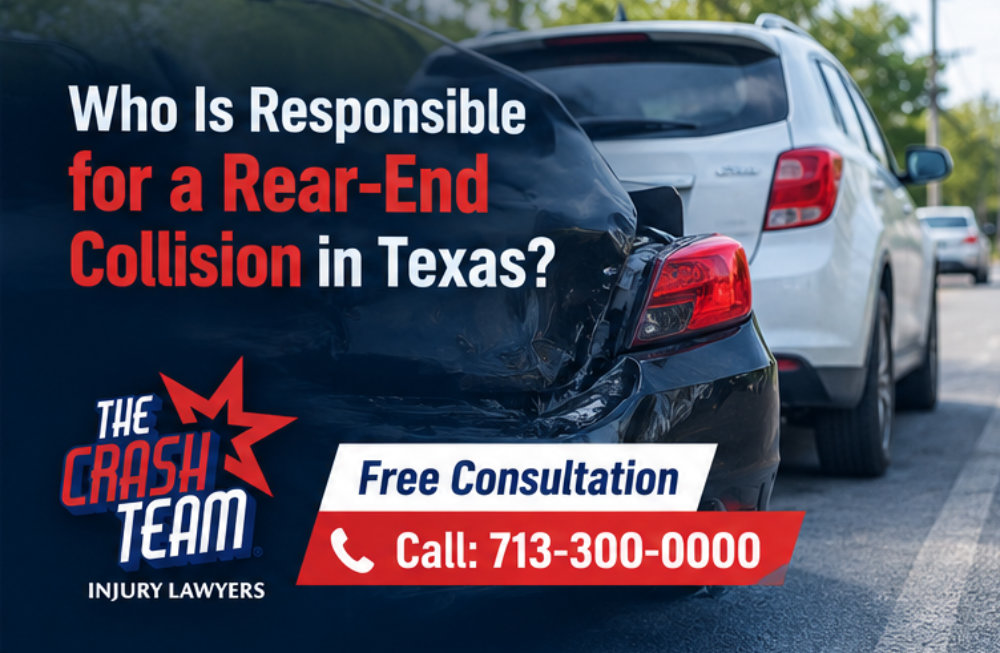
Rear-end crashes can cause far more than vehicle damage. Victims may suffer whiplash, herniated discs, traumatic brain injuries, spinal cord damage, broken bones, shoulder injuries, or permanent physical limitations. Determining responsibility is critical because the insurance company may dispute fault, minimize the injuries, or attempt to blame the injured person.
The Crash Team represents clients injured in rear-end collisions, freeway pileups, commercial truck crashes, rideshare accidents, and other serious motor vehicle accidents throughout Texas. Our legal team acts quickly to preserve evidence, identify every responsible party, document damages, and challenge insurance-company tactics.
Injured in a rear-end crash? Call a Texas car accident lawyer at 713-300-0000 or contact The Crash Team online for a free case review.
Is the Rear Driver Always at Fault in Texas?
No. Texas law does not create an absolute rule that the rear driver is automatically liable every time one vehicle strikes another from behind.
However, the rear driver is frequently found responsible because motorists have a duty to maintain enough distance to respond safely to traffic conditions. Texas Transportation Code Section 545.062 requires drivers following another vehicle to maintain an assured clear distance, considering the speed of the vehicles, traffic, and roadway conditions. The distance must be sufficient to allow the driver to stop safely without colliding with the vehicle ahead.
A rear driver may be negligent for:
- Following too closely
- Driving too fast for traffic or weather conditions
- Texting or using a phone
- Looking away from the road
- Driving while fatigued
- Driving under the influence
- Failing to maintain functional brakes
- Accelerating before the vehicle ahead begins moving
- Failing to notice stopped or slowing traffic
- Making an unsafe lane change behind another vehicle
Following too closely is among the common behaviors associated with Texas traffic collisions, according to the Texas Department of Transportation.
Even when the rear driver receives a citation, the injured person must still establish the elements of a civil claim. A traffic ticket can be useful evidence, but the insurance company may continue to dispute causation, injury severity, or the amount of damages.
When Is the Rear Driver Responsible for a Collision?
The rear driver is commonly responsible when the available evidence shows that the crash could have been prevented through reasonable attention, speed, or following distance.
Following Too Closely
Drivers must leave enough room to stop if traffic slows unexpectedly. The safe distance may depend on:
- Vehicle speed
- Traffic congestion
- Rain or fog
- Road construction
- Pavement conditions
- The size and weight of the vehicle
- Visibility
- The condition of the brakes and tires
A driver traveling on dry pavement at a low speed may need less stopping distance than a commercial truck traveling through rain on Interstate 10. Drivers must adjust to the actual conditions rather than relying on a fixed number of car lengths.
Distracted Driving
A driver who looks down at a text message may travel a significant distance without seeing stopped traffic. Phone records, dash cameras, vehicle data, witness statements, and social media activity may help establish distraction.
Rear-end and intersection collisions frequently occur when drivers focus on their phones rather than the roadway.
Distraction can also involve:
- Adjusting navigation
- Eating or drinking
- Reaching for an object
- Talking to passengers
- Applying makeup
- Looking at a roadside incident
- Interacting with children or pets
Speeding or Driving Too Fast for Conditions
A driver may be traveling below the posted speed limit and still be moving too fast for congested traffic, rain, poor visibility, or road construction. Speed affects both reaction time and stopping distance.
When traffic suddenly backs up near a freeway interchange, a driver who fails to reduce speed may cause a severe rear-end crash or multi-car pileup.
Impaired or Fatigued Driving
Alcohol, drugs, and fatigue can reduce reaction time and interfere with judgment. An impaired driver may fail to recognize brake lights, traffic signals, construction warnings, or stopped vehicles.
Evidence in these cases may include:
- Field sobriety test results
- Blood or breath test records
- Body-camera footage
- Bar or restaurant receipts
- Witness observations
- Prescription records
- Commercial driver logs
- Employment schedules
Defective Brakes or Poor Vehicle Maintenance
A driver or vehicle owner may be responsible when neglected brakes, worn tires, or another mechanical problem contributes to the crash.
In a commercial vehicle case, liability may extend to a trucking company, maintenance contractor, leasing company, or parts manufacturer. These cases should be investigated before the vehicle is repaired, sold, or destroyed.
When Can the Front Driver Be Responsible?
The driver of the front vehicle may bear some or all responsibility when that driver creates an unexpected and unreasonable hazard.
Broken or Missing Brake Lights
A driver may share responsibility if the vehicle’s brake lights were not functioning and the rear driver had no reasonable warning that the vehicle was slowing.
Evidence may come from:
- Photographs
- Video footage
- Vehicle inspections
- Repair records
- Witness statements
- Police observations
The rear driver may still be partially responsible for failing to maintain a safe distance. Liability depends on whether both drivers’ conduct contributed to the impact.
Sudden or Unsafe Lane Changes
A front driver who cuts into another lane without leaving adequate space may cause what appears to be a straightforward rear-end collision.
Dash-camera footage can be particularly important. Without video or witnesses, the front driver may claim to have been established in the lane long before the impact.
Reversing Into Another Vehicle
Not every collision involving front-end damage to one vehicle and rear-end damage to another is caused by the trailing driver. A driver may reverse unexpectedly:
- At a traffic light
- In a parking lot
- On a driveway
- After missing an intersection
- While attempting to parallel park
Surveillance video, dash-camera footage, and witness statements can prove that the vehicle ahead was moving backward.
Stopping Without Justification
Drivers sometimes must stop suddenly to avoid pedestrians, animals, debris, or another vehicle. An emergency stop does not automatically make the front driver negligent.
Responsibility may become an issue when a driver stops in a travel lane without a reasonable need, such as to argue with another motorist, check directions, or allow a passenger to exit.
Intentionally Causing the Collision
Rare cases involve road rage, brake-checking, or deliberate attempts to force another vehicle to crash. Evidence of intentional conduct can significantly affect the case and insurance coverage.
A deliberate act may also involve consequences beyond an ordinary negligence claim. An attorney should evaluate whether punitive damages or other legal remedies may be available.
Not sure who caused the collision? Let’s find out together. The Crash Team can investigate the crash before critical video, electronic data, or physical evidence disappears. Contact us today.
Can Both Drivers Share Responsibility?
Yes. Texas follows a proportionate-responsibility system. A claimant generally cannot recover damages when the claimant’s percentage of responsibility is greater than 50 percent. When the claimant is 50 percent or less responsible, compensation may be reduced according to that percentage.
Suppose a rear-end collision causes $200,000 in proven damages. A jury finds the rear driver 80 percent responsible and the injured front driver 20 percent responsible because the vehicle’s brake lights were not working.
The injured person’s recovery could be reduced by 20 percent, leaving $160,000.
If the injured person were found 51 percent responsible, that person generally could not recover compensation under Texas law.
Insurance companies understand how significant these percentages can be. An adjuster may attempt to assign blame by claiming that the injured driver:
- Stopped too suddenly
- Changed lanes before the crash
- Had defective lights
- Was distracted
- Was speeding
- Failed to use hazard lights
- Did not move a disabled vehicle
- Made the injuries worse by delaying treatment
The Crash Team uses physical evidence, records, expert analysis, and witness testimony to challenge blame-shifting that is not supported by the facts.
Who Else Could Be Responsible for a Rear-End Crash?
Liability may extend beyond the driver who caused the initial impact.
A Driver’s Employer
An employer may be responsible when an employee causes a crash while performing work-related duties. Examples may include:
- Delivery drivers
- Construction workers
- Utility employees
- Sales representatives
- Commercial truck drivers
- Home-service technicians
- Medical transportation drivers
The driver’s personal insurance may not be the only source of coverage. A commercial policy may apply, and the employer’s hiring, training, supervision, or vehicle-maintenance practices may also need to be investigated.
A Trucking Company
Rear-end crashes involving tractor-trailers can produce catastrophic injuries because of the truck’s size and weight.
A trucking company may be responsible for:
- Unsafe scheduling
- Hours-of-service violations
- Inadequate driver training
- Negligent hiring
- Failure to inspect the truck
- Defective brakes
- Improperly loaded cargo
- Failure to remove an unsafe driver
Electronic logging devices, dispatch records, maintenance files, onboard cameras, and engine-control data can be lost or overwritten. Sending preservation notices quickly is often critical.
A Rideshare Driver or Company
Insurance coverage in an Uber or Lyft collision may depend on what the driver was doing at the time. Different coverage may apply when the driver is:
- Logged out of the application
- Logged in and waiting for a request
- Traveling to pick up a passenger
- Transporting a passenger
An attorney can examine app records and insurance policies to identify the coverage available.
A Vehicle or Parts Manufacturer
A defective braking system, tire, sensor, or other component may contribute to a collision. Product-liability claims are complex and often require engineers or other technical experts.
The damaged vehicle should be preserved for inspection whenever a defect is suspected.
A Government Entity or Road Contractor
Poorly designed construction zones, missing warning signs, malfunctioning traffic signals, or dangerous roadway conditions may contribute to a rear-end crash.
Claims involving a government entity are subject to special notice and procedural rules. These deadlines can be much shorter than the ordinary personal injury filing period.
What Evidence Proves Responsibility in a Rear-End Collision?
Strong cases are built with evidence, not assumptions. The fact that one vehicle has rear damage and another has front damage does not always explain the full sequence of events.
Important evidence may include:
- The Texas Peace Officer’s Crash Report
- Photographs of the vehicles
- Photographs of the crash scene
- Dash-camera video
- Traffic-camera footage
- Business surveillance recordings
- Witness statements
- Driver admissions
- Phone records
- Vehicle event-data recorders
- Commercial driving logs
- GPS and rideshare application data
- Repair and maintenance records
- Skid marks and debris patterns
- Medical records
- Accident reconstruction analysis
TxDOT collects crash reports submitted by Texas law enforcement agencies for reportable crashes on public roadways and the state highway system.
A police report may identify contributing factors, citations, driver statements, road conditions, and witnesses. However, it is not always the final word on civil liability. Officers often arrive after the collision and must reconstruct events using the information available at the scene.
The Crash Team may conduct an independent investigation rather than relying exclusively on the insurance company or police report. The firm’s attorneys can analyze reports, preserve electronic evidence, interview witnesses, and identify parties beyond the individual driver who may be responsible.
How The Crash Team Builds a Rear-End Collision Case
The Crash Team prepares injury cases with litigation in mind. That means looking beyond the surface-level assumption that a rear-end crash is simple.
The legal team may:
- Investigate the collision immediately
- Secure police and crash records
- Locate witnesses
- Demand preservation of video and electronic data
- Inspect the vehicles
- Work with accident reconstruction experts
- Review phone records and driving logs
- Identify commercial insurance policies
- Gather medical evidence
- Calculate current and future losses
- Negotiate with insurance carriers
- File a lawsuit when fair compensation is denied
The Crash Team handles car accidents, truck accidents, motorcycle crashes, rideshare collisions, pedestrian and bicycle accidents, catastrophic injuries, wrongful death claims, and other serious Texas personal injury matters. The firm emphasizes same-day callbacks, immediate case evaluations, and 24/7 availability.
Contact The Crash Team After a Texas Rear-End Collision
The rear driver is often responsible for a rear-end accident, but insurance companies do not always accept liability without a fight. They may dispute how the crash happened, blame the front driver, question medical treatment, or make an early offer that fails to cover the victim’s long-term losses.
The Crash Team investigates the complete sequence of events and pursues every party whose negligence contributed to the collision. Led by Aaron Galvan and Breanne Galvan, the legal team combines serious litigation preparation with direct, client-first representation.
Call The Crash Team today at 713-300-0000 for a free consultation. We are available 24 hours a day, seven days a week, and clients pay no attorney fees unless compensation is recovered.
