The Crash Team | March 3, 2026 | Car Accidents
Self-driving cars are no longer a futuristic concept. They are already sharing Texas roads with everyday drivers, and that means one thing for accident victims: liability questions are getting more complicated. When a crash involves automation, the first question is not always “Who was driving?” It is often “Who was responsible for the technology, the decision-making, and the safety systems in control?”
For people injured in Sugar Land and across Texas, these cases can feel confusing and even intimidating. A self-driving car accident can involve multiple insurance companies, corporate legal teams, and technical evidence that is not obvious at the crash scene. Understanding how liability works is the first step toward protecting your rights and pursuing the full compensation you deserve.
Have you been injured in a Texas car accident involving a driverless car? Reach out to a Texas car accident attorney at The Crash Team today. We’re available 24/7. Call us at 713-300-0000 or contact us online for a free consultation.
Why Self-Driving Car Accidents Create New Liability Problems
In a traditional car accident, liability usually comes down to driver behavior: speeding, distraction, failure to yield, or following too closely. Self-driving technology changes that dynamic. Some vehicles operate with partial automation (like lane-keeping or adaptive cruise control), while others are designed to drive with minimal human input under specific conditions.
The challenge is that “self-driving” is often a marketing term, not a legal category. Many crashes happen because drivers misunderstand what the system can do, or because the system fails in predictable scenarios, such as construction zones, poor lighting, or heavy rain.
Liability becomes more complex because responsibility may be shared among:
- The human driver
- The vehicle owner
- The manufacturer
- The software developer
- A third-party maintenance or repair shop
Texas injury law can still apply cleanly, but these cases require deeper investigation. The party that caused the crash is not always the party sitting behind the wheel.
The Role of Texas Negligence Law in Self-Driving Crashes
Texas handles most car accident claims through negligence law. That means the injured person must show that someone owed a duty of care, breached that duty, and caused damages. The difference in self-driving cases is that the “someone” may be a company or corporation rather than a single driver.
Texas also follows a modified comparative fault rule. If you are more than 50 percent responsible for the crash, you cannot recover damages. If you are 50 percent or less responsible, your compensation is reduced by your percentage of fault.
This matters because insurers often try to shift blame onto the injured person, especially in cases involving advanced technology. For example, if you collided with a self-driving car that stopped unexpectedly, an insurer may argue you were following too closely. Meanwhile, the technology company may argue their system behaved correctly, and you were the true cause.
These cases often turn into a fault-allocation battle. Strong evidence and strategic legal positioning make a real difference.
When the Human Driver Is Still Responsible
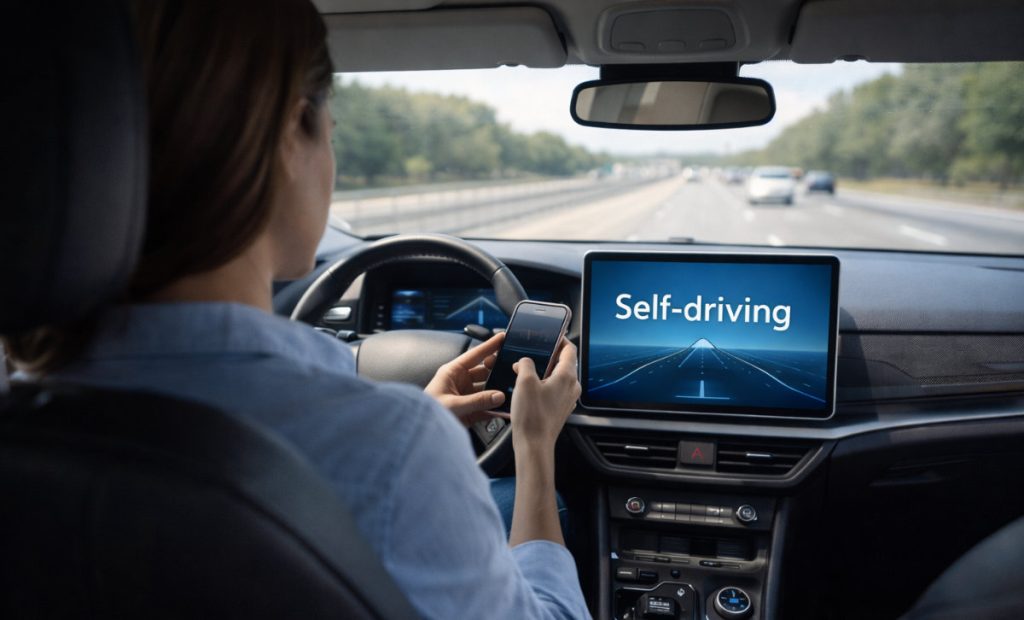
A major misconception is that self-driving cars remove human responsibility. In many cases, the human driver still has a legal duty to monitor the vehicle and intervene when needed. This is especially true for partially automated systems.
If a driver uses “autopilot” features irresponsibly, such as taking their hands off the wheel for extended periods or failing to pay attention, liability may fall on them. Texas juries tend to view these situations as avoidable, particularly when warnings are present.
Examples of driver-based liability in self-driving crashes include:
- Treating a driver-assist system like a fully autonomous system
- Failing to brake or steer when a hazard is obvious
- Driving while distracted because “the car is handling it”
- Using automation outside its intended conditions
This is where the real-world side of these cases matters. People trust technology. They also get tired, rushed, or complacent. Unfortunately, insurance companies are not sympathetic to that reality.
When the Manufacturer or Software Company May Be Liable
Some self-driving crashes point to defects in the vehicle, sensors, or software logic. When that happens, the case can shift from a standard negligence claim into a product liability claim. Texas product liability law allows injured victims to pursue compensation when a product is unreasonably dangerous due to design defects, manufacturing defects, or inadequate warnings.
A self-driving system can fail in several ways. The sensors may not detect a pedestrian. The software may misinterpret a lane marking. The system may brake suddenly or accelerate unexpectedly. These failures can cause devastating crashes even when surrounding drivers are doing everything right.
Product liability claims may involve:
- Faulty cameras, radar, or lidar systems
- Software defects or updates that create unsafe behavior
- Inadequate warnings about system limitations
- Poor system performance in predictable driving environments
These cases are more technical and more heavily contested. They often require expert analysis, data downloads, and aggressive legal action to obtain corporate evidence.
The Importance of Vehicle Data and “Black Box” Evidence
Self-driving vehicles generate enormous amounts of data. That data is often more valuable than witness statements, because it can show exactly what the vehicle was doing in the moments before impact. Many vehicles record speed, braking, steering inputs, sensor detection, and whether automation features were engaged.
The problem is that this evidence is not always easily accessible. Manufacturers and insurance companies may control it, and the data may be overwritten if not preserved quickly. That is why early legal intervention is so important.
Key evidence in self-driving accident cases may include:
- Event data recorder (EDR) downloads
- Camera footage from onboard systems
- GPS and route history
- Software version and update records
- Driver monitoring data (hands-on-wheel alerts, attention warnings)
These cases often become evidence races. The party that secures the data first typically has the advantage in negotiations and litigation.
How Liability Is Shared When Multiple Parties Contributed
Self-driving accidents frequently involve shared responsibility. The driver may have been inattentive, but the system may also have failed. A third-party repair shop may have improperly calibrated sensors. Another driver may have cut into the lane unexpectedly. In Texas, liability can be split among multiple parties.
This is where self-driving accident cases begin to resemble commercial truck accident litigation. There may be multiple defendants, multiple insurers, and competing narratives about who caused what. From a legal strategy standpoint, identifying every responsible party is not optional; it is often the only way to secure full compensation.
Common liability combinations include:
- Driver negligence plus system failure
- Manufacturer defect plus inadequate driver training
- Sensor miscalibration plus poor roadway signage
- Another driver’s negligence plus the self-driving misjudgment
These cases require careful analysis. If one party is left out, the injured person may be stuck with a settlement that does not cover long-term medical costs, lost wages, or permanent disability.
What the Legal Process Looks Like in a Self-Driving Car Accident Case
Self-driving accident claims tend to move differently than standard fender-benders. Insurance companies are more cautious, and corporate defendants often resist transparency. That does not mean you cannot win; it means the case must be built correctly from day one.
A typical case process includes:
- Initial consultation and case evaluation: Your attorney reviews the crash facts, injuries, and vehicle type involved.
- Investigation and evidence preservation: This includes sending preservation letters for vehicle data, camera footage, and maintenance records.
- Liability analysis and expert review: Accident reconstruction experts and technical specialists may evaluate system behavior.
- Insurance negotiations and demand package: Your legal team presents damages supported by medical records, wage documentation, and long-term projections.
- Litigation if negotiations stall: A lawsuit may be necessary to obtain corporate records and force accountability.
A simple comparison is helpful here. Settlement can be faster, but trial may be necessary when a manufacturer or software company refuses to accept responsibility. The Crash Team prepares cases with litigation in mind, which often improves settlement outcomes without sacrificing leverage.
Injured in an Accident Involving a Driverless Car? Call The Crash Team Today!
Self-driving car accident claims are not built on assumptions; they are built on evidence. When automation, software, and corporate defendants enter the picture, it becomes easier for insurers to delay, deny, or shift blame. The Crash Team helps you cut through that confusion by investigating the crash thoroughly and identifying every party that contributed to your injuries.
Led by attorneys Aaron Galvan and Breanne Galvan, The Crash Team brings serious litigation experience and a client-first approach to complex vehicle accident cases. Whether your crash involves a partially automated car or a fully autonomous system, the firm is prepared to pursue the compensation you deserve under Texas law.
If you were injured in a car accident involving self-driving technology in Sugar Land or anywhere in Texas, do not try to navigate this alone. Contact The Crash Team today for a free consultation, or call us 24/7 at 713-300-0000 and take the next step toward protecting your recovery and your future.
