
The Crash Team | April 28, 2026 | Truck Accidents
Truck accidents are some of the most devastating crashes on Texas roads. With massive vehicles, high speeds, and crowded highways, the damage can be life-changing.
But when a truck accident happens, one of the first questions is who is actually responsible. In many cases, it is not just the driver. Understanding driver liability, and how it fits into the bigger picture, can directly impact your ability to recover compensation.
Injured in a Texas truck accident? If you suspect the truck driver may be at fault, reach out to a truck accident lawyer at The Crash Team. Call us 24/7 at 713-300-0000 or contact us online for a free consultation.
Who Is Liable in a Texas Truck Accident?
In Texas, liability in a truck accident depends on who caused the crash and why it happened. Unlike a typical car accident, truck cases often involve multiple layers of responsibility.
While the truck driver may be at fault, other parties are frequently involved, including:
- The trucking company
- Maintenance providers
- Cargo loading companies
- Vehicle or parts manufacturers
Texas follows a fault-based system, which means responsibility must be established before compensation is awarded. Under Texas Civil Practice and Remedies Code §33.001, your ability to recover damages depends on proving that another party was primarily at fault.
Because of this structure, identifying every responsible party is critical.
When Is the Truck Driver Liable?
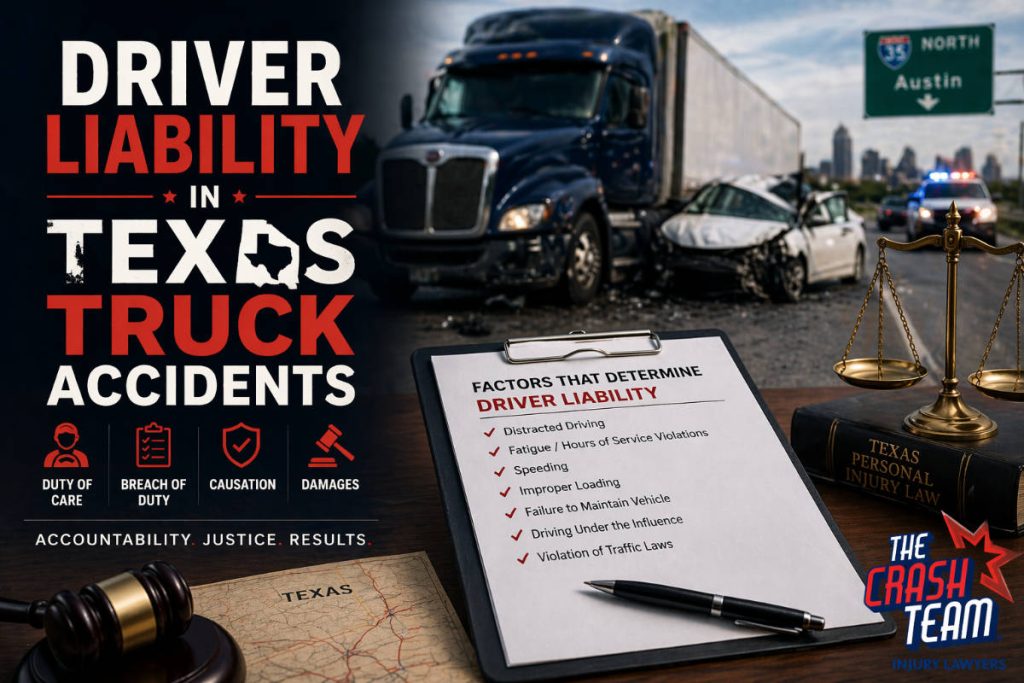
Truck drivers can be held responsible when their actions directly lead to a crash. Due to the size and weight of commercial vehicles, even minor errors can result in serious consequences.
Common examples of driver negligence include:
- Distracted driving, such as phone use or GPS adjustments
- Fatigue or falling asleep behind the wheel
- Speeding or aggressive driving
- Driving under the influence
- Failing to check blind spots
- Improper lane changes
Texas traffic laws, including Texas Transportation Code §545.060, which governs lane usage, often come into play when determining fault. Violations of these rules can strongly support a claim of negligence.
In many cases, proving driver liability is the first step, but it is rarely the only step.
How Federal and Texas Laws Affect Driver Liability
Truck drivers are subject to both federal and state regulations. These rules are designed to promote safety, but violations can also serve as powerful evidence in a legal claim.
Key regulations include:
- Hours of Service rules, which limit how long drivers can operate without rest
- Required pre-trip and post-trip vehicle inspections
- Weight and cargo securement standards
- Commercial licensing and training requirements
If a driver violates these rules, it can establish negligence. For example, exceeding driving limits or skipping inspections may demonstrate a failure to follow safety standards.
Additionally, under Texas Transportation Code §601.072, commercial vehicles must carry specific insurance coverage. This requirement can affect how claims are paid and which policies apply.
These legal frameworks often work together to shape the outcome of a truck accident case.
What If the Truck Driver Was Fatigued?
Driver fatigue is one of the leading causes of truck accidents. Long hours on the road, combined with demanding schedules, can push drivers beyond safe limits.
Even with regulations in place, some drivers:
- Exceed legal driving hours
- Falsify logbooks or electronic records
- Skip required rest breaks
Fatigue slows reaction time and impairs judgment, similar to alcohol impairment. When fatigue is involved, liability may extend beyond the driver.
If a company encourages unrealistic schedules or fails to enforce rest requirements, it may share responsibility. This is where the case begins to expand beyond individual negligence.
Can the Trucking Company Be Responsible?
Yes, and often they are. Even if the driver caused the crash, the trucking company may still be liable under legal principles that hold employers accountable for their employees’ actions.
This applies when:
- The driver was working at the time of the accident
- The company failed to properly train or supervise the driver
- The company encouraged unsafe driving practices
In addition, companies may be directly liable for their own actions, such as:
- Hiring unqualified or inexperienced drivers
- Ignoring safety violations
- Failing to maintain vehicles
Under Texas Civil Practice and Remedies Code Chapter 41, which addresses damages in civil cases, proving company negligence can significantly impact the amount of compensation available.
This broader liability often leads to higher insurance coverage and more complex litigation.
What Evidence Is Used to Prove Liability?
Truck accident cases rely heavily on detailed and technical evidence. Unlike standard car accidents, these cases often involve data from multiple sources.
Key evidence may include:
- Driver logs and electronic logging device data
- Black box or event data recorder information
- Maintenance and inspection records
- Dashcam or surveillance footage
- Police reports
- Witness statements
- Accident reconstruction analysis
This evidence must be preserved quickly. Trucking companies and insurers often begin their own investigations immediately, which can put victims at a disadvantage if they delay action.
Strong evidence not only proves liability but also prevents insurers from shifting blame.
What Happens If Multiple Parties Are at Fault?
Texas follows a modified comparative negligence rule, which means multiple parties can share responsibility for an accident.
Under Texas Civil Practice and Remedies Code §33.001, each party is responsible for their percentage of fault. If you are found to be more than 50 percent at fault, you cannot recover damages.
For example:
- Driver, 40 percent at fault
- Trucking company, 40 percent at fault
- Cargo loader, 20 percent at fault
Each party may be required to contribute to your compensation based on their share of liability.
This system makes it essential to identify every responsible party. Missing even one can reduce the total compensation available to you.
How Liability Affects Your Compensation
Liability directly influences the outcome of your claim. The clearer and stronger your case, the more likely you are to recover full compensation.
You may be entitled to damages for:
- Medical expenses
- Future medical care
- Lost wages
- Reduced earning capacity
- Pain and suffering
- Property damage
When liability is disputed, insurers often attempt to assign partial blame to reduce payouts. This is especially common in high-value truck accident cases.
Building a clear, evidence-based case helps counter these tactics.
What Makes Truck Accident Cases More Complex?
Truck accident claims are more complicated than typical car accident cases for several reasons.
- Multiple parties may be involved
- Federal and state regulations apply
- Large insurance policies are at stake
- Companies aggressively defend claims
- Evidence is more technical and time-sensitive
Insurance companies representing trucking companies often act quickly to protect their interests. They may deploy investigators, gather evidence, and build defenses within hours of the crash. Knowing how to deal with the insurance companies and taking early action is critical to leveling the playing field.
What You Should Do After a Truck Accident
The steps you take immediately after a truck accident can have a lasting impact on your case.
To protect your claim:
- Seek medical attention right away
- Call law enforcement and obtain an official report
- Document the scene with photos and videos
- Collect contact information from witnesses
- Avoid speaking with trucking company insurers
- Do not accept early or low-ball settlement offers
These actions help preserve evidence and strengthen your ability to prove liability.
When Should You Contact a Lawyer?
Truck accident cases require fast, strategic action. You should consider contacting an attorney as soon as possible after the crash.
Legal guidance is especially important if:
- You were involved in a truck accident
- Your injuries are serious or long-term
- Liability is unclear or disputed
- The trucking company contacts you
- You receive a settlement offer
Early legal support can prevent mistakes, protect evidence, and improve your chances of a successful outcome.
How The Crash Team Handles Truck Accident Liability
At The Crash Team, we understand the complexity of truck accident cases and the tactics used by large trucking companies. Our approach is thorough, strategic, and focused on results.
We:
- Investigate every aspect of the crash
- Identify all liable parties
- Secure critical evidence before it disappears
- Work with industry experts and accident reconstruction specialists
- Handle aggressive insurance defense strategies
- Build cases designed for maximum compensation
We do not stop at the driver. We examine the entire operation behind the accident to uncover every source of liability.
Let The Crash Team Hold the Right Parties Accountable and Maximize Your Compensation
Truck accident liability is rarely straightforward, and insurance companies rely on that complexity to limit what they pay. The more complicated the case becomes, the easier it is for them to shift blame and reduce your recovery.
At The Crash Team, we cut through that complexity and build strong, evidence-backed claims that hold every responsible party accountable. We handle 18-wheeler, company vehicle, and other truck accident cases on a contingency basis, which means you pay nothing unless we win.
If you have been injured in a truck accident in Texas, call The Crash Team today at 713-300-0000, or contact us online for a free consultation and take the first step toward securing the compensation you deserve.
